A Notice People Can Act On: Put the Next Step in Plain Sight
A clear local notice helps neighbors understand what is happening, check whether it suits them, and take the right next step without chasing missing details.
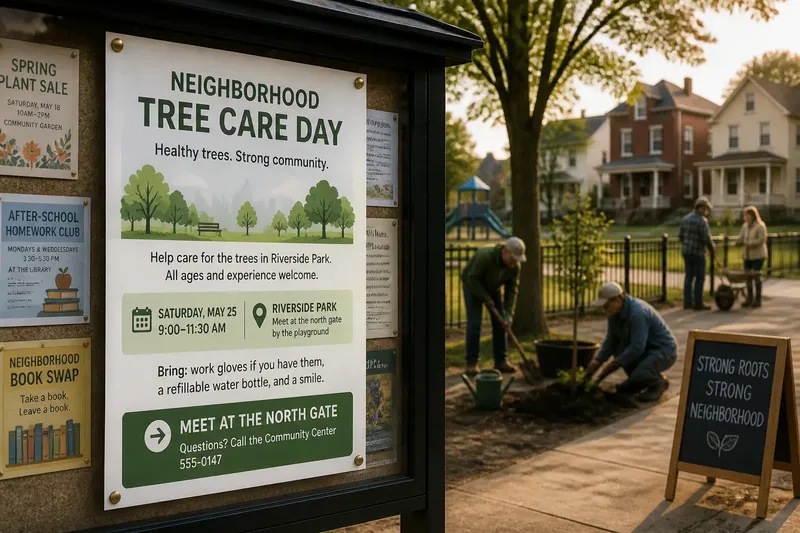
The most common mistake in a local notice is naming an event but leaving the reader to work out what to do. A resident may see “Park planting day” on a library board, yet have no way to tell when to arrive, whether help is needed, or whom to contact; the notice has attracted attention but not participation. A useful notice puts its next action where a reader can see it immediately.
That action is the small bridge between knowing and taking part. It might be “Meet at the north gate,” “Bring a mug,” or “Call the community center to reserve a place.” The details around it should help a neighbor decide whether and how to act, not compete with it for attention.
Start by deciding what a reader should do
Before drafting, name one primary next step. If the notice asks readers to register, bring supplies, send feedback, and share the announcement all at once, they may not know which request matters most. Supporting requests can appear later, but one action should lead.
Choose an action that can be expressed as a verb and a concrete object or place: “Reply to the council office,” “Bring a photo of the damaged bench,” or “Join the route walk at the west entrance.” Avoid vague directions such as “Get involved” or “Learn more” unless the notice immediately explains how.
Say you are announcing a neighborhood tree-care session. “Help care for the trees” expresses a purpose, but it does not tell a passerby what to do. “Meet the parks crew beside the playground gate on Saturday morning” gives a clear starting point; a line below can explain how to ask about access needs or other arrangements.
Build the notice around purpose and essential details
Readers need enough context to decide whether the invitation concerns them. State the purpose in a plain sentence: what is happening, what local place or issue it concerns, and why people are being invited. “Neighbors will review possible lighting changes for the path” is more informative than “Community meeting.”
Then supply the details that make the next step possible. Depending on the notice, these may include:
- Who: The intended audience, host, or contact person.
- What: The activity, decision, or request.
- When: The day and start time, plus an end time when it helps people plan.
- Where: A named venue and a useful entrance or meeting point.
- How: The way to reply, register, attend, or send information.
- What to bring: Only items participants are actually asked to provide.
Not every notice needs every item. A request for written comments may need a deadline and a submission address instead of a meeting place. A public gathering may need both a venue and a contact for access questions. Include what a reader needs for the decision, and leave out details that do not change it.
Imagine a block association inviting residents to discuss a proposed mural. Its draft says, “Come talk about the wall next week.” A clearer version names the meeting room, gives the date and start time, says the discussion is about design choices, and directs residents to email the association secretary if they cannot attend but want to comment. A neighbor can now judge whether to come or send a response.
Put the action where the eye lands
A notice works like a labeled envelope: the outside should tell you what it contains and what to do next, before you inspect every detail. Give the main invitation a prominent place, then put its action directly beneath it or in a clearly marked final line. The reader should not have to search a dense paragraph for the contact method.
Use ordinary words and familiar place names. “Use the side entrance on Cedar Street” is more helpful than “enter via the secondary access point,” especially when a building has several doors. If a map or QR code is included, retain a written address or contact route so the notice still makes sense without a phone.
Keep the visual design in service of the message. A readable type size, strong contrast, and open space can make the action easier to spot; decorative borders and several competing colors cannot replace missing information. On a printed notice, check that the text remains legible from a comfortable standing distance and that key lines do not disappear into a busy background.
Use a week to remove ambiguity before posting
A short drafting routine can catch gaps without turning a simple announcement into a committee project. Begin with the action, add the details that make it possible, and set aside time for a reader to check what remains unclear.
- Early in the week: Confirm the purpose and choose the one main action. Ask the organizer what response they need from a reader.
- After that: Gather the event or submission details, including the exact location, contact route, and any relevant access information. Do not fill gaps by guessing.
- Midweek: Draft the notice in plain language. Put the invitation and action near the top, then add only the supporting context needed to make a decision.
- Before sharing: Ask someone unfamiliar with the plan to read it and answer: What is happening? When and where? What should I do next?
- On posting day: Check the printed or digital version as readers will encounter it. Make sure links work, contact details are visible, and any stated deadline or venue is still current.
- After posting: Watch for questions that reveal a missing detail. Update the notice through the same channels where possible, and remove or mark outdated copies so an old instruction does not remain in circulation.
This routine is flexible: a notice for a meeting tomorrow may need a quick check rather than a full week. The useful principle is to leave enough time for someone outside the organizing group to spot assumptions that insiders no longer notice.
Check whether a reader can act without guessing?
What belongs in the first line?
Name the event, request, or local issue in language a passerby can understand. If space allows, include the relevant neighborhood place or group so readers can quickly tell whether the notice concerns them.
How much detail is enough?
Include the information needed to decide and take the stated action, such as a meeting time and location or a response deadline and submission route. Leave out background that does not change that decision; provide a contact for questions that need a longer explanation.
What if the organizer is still confirming a detail?
Do not present an uncertain time, room, or contact as settled. Either wait to post, or say plainly what is pending and where the confirmed information will appear, using a channel readers can access.
How can a notice welcome people who need another way to take part?
Offer a real contact route for questions or an alternative way to contribute, such as sending comments by email when attendance is not possible. State the option clearly, without implying that every accommodation or format is available unless the organizer has confirmed it.
Keep each notice honest and current
A notice should not promise what its organizer has not arranged. If refreshments, interpretation, seating, or a particular activity are uncertain, omit the claim or identify it as pending and say where readers can check. For local requirements and venue details, use the responsible organization’s current information rather than relying on an old flyer or a neighbor’s recollection.
When plans change, update the notice promptly and make the change easy to notice. If the meeting moves to another room, the new location should replace the old one wherever the announcement appears; adding a quiet correction to one copy may leave other readers heading to the wrong door.
For a local notice, the main search phrase “clear local notice” points to a useful editorial test: can a neighbor understand the purpose, find the essential details, and identify one next action without asking the organizer to translate? If not, remove ambiguity before adding decoration. A few precise lines can make the difference between a message someone merely sees and an invitation they can actually answer.