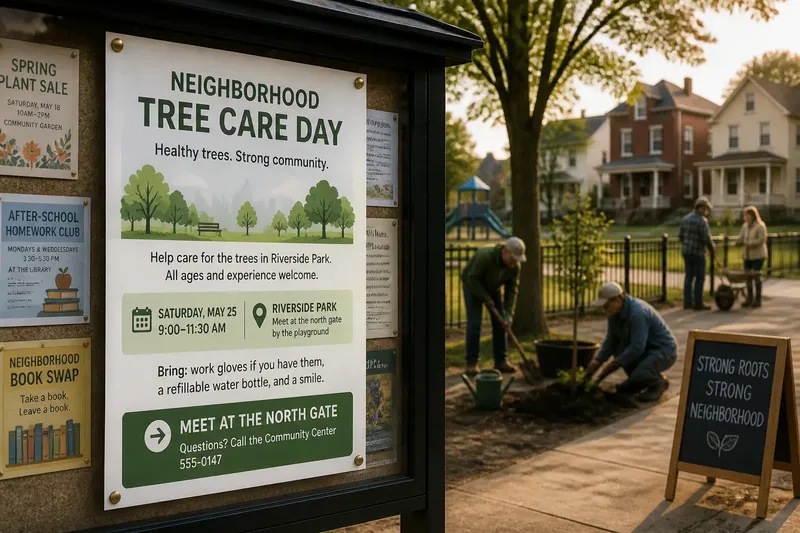
Before the Community Bulletin: How Local News Reached a Doorstep
See how printed neighborhood notices carried local news, and how their placement and delivery shaped who could encounter a message and what it left out.
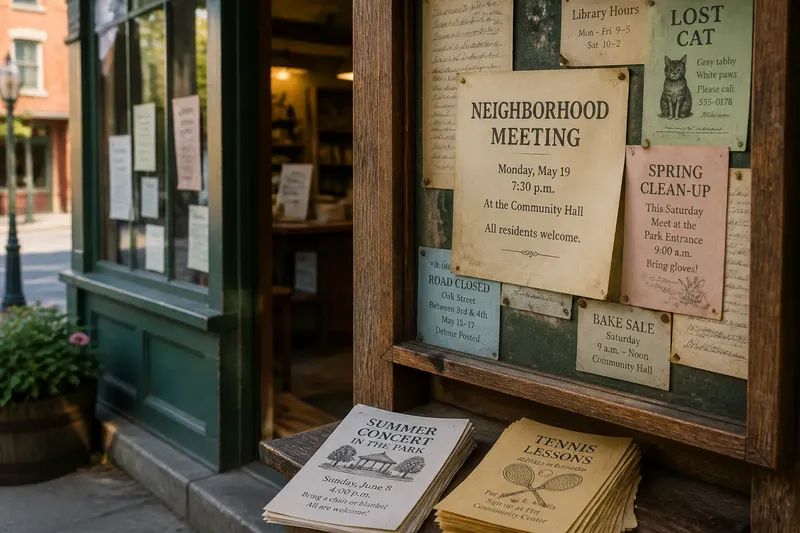
The common mistake in remembering local news is to assume a printed notice reached everyone simply because it was posted. A sheet could be clear and timely yet miss households beyond a shop window, meeting room, or familiar route. Printed neighborhood notices depended not only on their wording but also on where copies went and who could reach them.
A neighborhood notice was defined by its local purpose
A neighborhood notice was a short message intended for people connected to a particular locality. It might announce a meeting, a road closure, a lost object, a local service, or a change in how a shared place could be used. Unlike a newspaper, it did not need to cover events across a broad region.
The term describes a purpose more than a fixed format. A notice might be a handwritten sheet, a printed handbill, an item in a local circular, or a page on a noticeboard. What connected these forms was their reference to local names, landmarks, and concerns.
People and organizations with modest resources could prepare such messages: a clerk, shopkeeper, association, congregation, or municipal office, for instance. Printing made it possible to reproduce a message, but local usefulness came from its connection to a particular place and audience.
Print made a message available beyond its author
A printed copy could remain in place after the person who posted it had left. A passerby might read it later, and a handbill could travel from one household to another. These qualities made paper useful for meeting announcements and other messages that people needed to consult at different times.
A fixed sheet and a portable handbill worked differently. The sheet stayed where it was posted and served people who passed that spot; a handbill could move with the person carrying it. Neither route worked by itself: someone had to prepare the words, arrange the copies, and put them where intended readers might encounter them.
Placement shaped who could encounter a notice
Notices could appear in shop windows, post offices, libraries, community halls, market entrances, or workplaces. Each location brought a different set of passersby. A notice inside a meeting hall was readily available to people who already used that organization, while a shop-window sheet could be seen by people following other routines.
Visibility depended on practical details. A window might be hard to see from the sidewalk, a building might not be open when a reader passed, or the notice might be covered by newer sheets. A central posting place could be familiar to some residents and inconvenient for others.
Reach therefore meant more than how many copies existed. It also depended on where they appeared, which routes people took, and whether someone could pause to read them. A public posting could still serve a narrow circle if only that circle regularly used the location.
Printed neighborhood notices could exclude as well as inform
People who regularly visited a posting place had the clearest chance of seeing its notices. Residents who used different routes, could not enter a particular building, or did not know where local information was posted might miss them. A handwritten or crowded sheet could also be difficult to read, and a notice in one language would not serve every reader.
Paper was one channel among several. Neighbors might pass news through conversation, workplace talk, gatherings, or direct visits. Those routes could supplement a printed sheet, but they depended on social connections and did not necessarily reach every household either.
Format influenced what a notice could say
A small handbill encouraged a compact announcement. A noticeboard could display several messages at once, though readers had to pick out one from the others. A local circular could offer more context to its regular readers, while its circulation depended on how copies were distributed.
Clear headings and short paragraphs helped readers identify a notice's subject and main points. Handwritten updates could keep information current, but crowded additions might make a page harder to understand. The format shaped both the amount of context and the ease of finding it.
Some papers were discarded after an event; others might be retained by an organization or bound into a collection. A surviving copy records what someone chose to print and preserve, not every conversation or concern in the neighborhood.
Local notice systems could overlap rather than replace one another
In some communities, people may have used occasional sheets, shared boards, recurring circulars, and organized distribution at the same time. These forms did not necessarily develop in a single sequence or displace one another. Without a particular place and period to examine, it is safer to describe them as possible coexisting arrangements than as a universal history.
A residents' association, local authority, club, or congregation might maintain a board or circulate a bulletin among people connected to it. Such arrangements could make information easier to find within a group, while leaving people outside that group less likely to see it.
Say a fictional neighborhood association posts a meeting notice only inside its hall. Members who visit may encounter it, while residents who use the nearby market but never enter the hall may not. If the association also places a copy at a public counter used by those market-goers, the observable result is that the notice appears on another route; it still does not mean every household has received it.
A community bulletin gathered messages in a different way
A loose notice usually focused on one immediate message and one posting or distribution occasion. A community bulletin brought multiple items together in a recurring publication or organized display. Readers could find several announcements in one place, but someone had to select, edit, and arrange them.
Those choices shaped what readers saw. An editor or organizer decided which items belonged, how much space to give each, and when old material should be removed. A single sheet could be direct and temporary; a bulletin could gather more context, but its contents reflected the priorities of its compiler.
Neither format was inherently more inclusive. A bulletin might circulate only among subscribers or members, while a loose notice might be visible to passersby but provide little background. The important question is how a particular message traveled and who encountered it.
Readers often ask how printed local notices worked
Were notices posted or delivered?
They could be posted, handed out, enclosed with other papers, or passed from person to person. The method depended on the message, available helpers, and the places residents used.
Did every notice come from a public office?
No. Local groups, businesses, congregations, clubs, and individuals could also circulate information. A notice displayed in a public place was not necessarily produced or approved by a government office.
Why might a notice be hard to find later?
Many notices were temporary and could be removed, discarded, or covered by newer sheets. Unless someone kept a copy or an organization retained a record, the message might leave little trace.
Could printed notices reach people who could not read them?
Not through the printed words alone. Another person could read a notice aloud or relay its contents in conversation, but that depended on a social connection rather than on the paper itself.
The doorstep changed the route into a household
A paper delivered to a home followed a different path from one posted in a shared place. It could reach someone who did not pass a noticeboard, but delivery depended on access to the household and a way to carry copies there. Street-by-street delivery and personal networks shaped which homes were included.
A delivered sheet might feel addressed to a household, while a public posting asked residents to seek information out. Neither arrangement reached everyone automatically: delivery depended on its route, and public posting depended on a reader's movements and knowledge of where to look.
The search phrase printed neighborhood notices points to a useful distinction: a notice was both a message and a route through a particular place. To understand who could encounter local news, look beyond the surviving words and ask who prepared the paper, where copies appeared, and which households could reach those places. That route helps explain why neighbors could have different access to the same announcement.